
Globus Medical’s latest results created an apparent contradiction. The company reported a very strong first quarter, raised its earnings guidance, continued to show the benefits of the NuVasive integration, and reinforced its position as one of the leading players in spine. Yet the stock did not move as many would have expected. In fact, the immediate market reaction was negative. For spine executives, distributors and medtech investors, the question is not simply why the share price fell. The more relevant question is what the market is now demanding from Globus Medical.
The numbers themselves were not weak. Globus reported first-quarter 2026 net sales of $759.9 million, up 27.0% year over year, or 25.5% on a constant currency basis. Excluding Nevro, the base business generated $677.2 million, up 13.2% as reported. GAAP diluted EPS was $0.90, and non-GAAP diluted EPS reached $1.12. The company also reaffirmed full-year 2026 revenue guidance of $3.18 billion to $3.22 billion and raised non-GAAP EPS guidance to $4.70–$4.80, from the previous range of $4.40–$4.50.
That is not a disappointing quarter. It is a strong quarter. Revenue beat expectations, earnings beat expectations, profitability improved, and guidance was raised on EPS. According to financial commentary after the results, the company’s non-GAAP profit of $1.12 per share was more than 20% above consensus, while revenue also came in ahead of estimates.
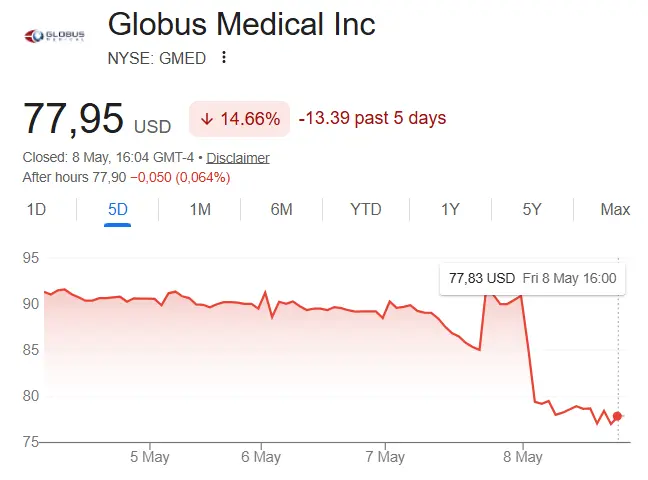
So why did the stock fall?
The first explanation is that the market had already priced in a lot of good news. Globus had entered 2026 with improving sentiment. The NuVasive integration appeared to be working better than some investors initially feared. The company was showing margin expansion. Spine momentum remained solid. Enabling technologies were still strategically relevant. In that context, a good quarter may not be enough. When expectations rise, the stock needs more than operational quality; it needs a new reason to re-rate.
The second issue is the difference between earnings guidance and revenue guidance. Globus raised EPS guidance, but it did not raise full-year revenue guidance. That matters. For a company that investors increasingly view as a high-quality growth platform, the market may have wanted evidence that 2026 sales would move above the existing plan. Instead, management reaffirmed the revenue range. That is not necessarily negative. It may simply be disciplined guidance. But public markets often read unchanged revenue guidance after a strong Q1 as a signal that the rest of the year may not be as explosive as the first quarter looked on the surface. TipRanks noted that the reaffirmed 2026 revenue range implies roughly 8.2% to 9.6% growth, while the raised EPS range points to stronger profit expansion.
The third factor is valuation. Globus is no longer being valued as a simple spine implant company. It is being valued as a larger musculoskeletal technology platform, with spine, trauma, enabling technologies, neuromonitoring, pain management and a broader procedural ecosystem. That strategic expansion is powerful, but it also makes the equity story more demanding. Investors are no longer asking only whether Globus can grow. They are asking whether it can grow, integrate acquisitions, expand margins, sustain commercial discipline, and protect its technology premium at the same time.
Is the current valuation too high?
The answer is not obvious. Some market sources still suggest that Globus may not be overvalued relative to its growth and earnings profile. Investing.com reported after the Q1 release that the stock remained below its 52-week high and cited analyst price targets ranging from $90 to $123. GuruFocus commentary also referenced a current P/E ratio around 21.6x, which would not appear excessive for a company delivering this level of earnings growth, although valuation metrics should be treated carefully because they depend on methodology, earnings base and market conditions.
The more precise point is this: Globus may not be obviously expensive, but it is no longer cheap enough for investors to ignore execution risk. The stock needs consistent proof that the strategy can keep compounding.
NuVasive is central to that discussion. The integration seems to have moved from defensive explanation to strategic advantage. Globus has combined two major spine organizations, preserved commercial momentum, expanded scale and improved its position in the spine market. It is reasonable to say that Globus may now be one of the strongest — and possibly the leading — spine companies globally, depending on how one defines leadership: U.S. spine share, global spine revenue, procedural breadth, enabling technology penetration or profitability. However, unless ranking data is independently confirmed, “number one in spine” should be framed as a likely strategic position or market perception, not as a certified fact.
The industry should not underestimate the importance of this. NuVasive was not just an acquisition of revenue. It added surgeon relationships, product depth, lateral spine strength, international presence and commercial density. If the integration continues to work, Globus could become a harder competitor across multiple spine categories. It can offer implants, robotics, navigation, procedural support and a broader hospital relationship. That is not the profile of a traditional implant vendor. It is closer to a procedural platform.
So, why the stock reaction was cautious?
The market is asking whether that platform can remain simple enough to execute. Globus has added NuVasive. It has added Nevro. It is expanding across technologies and segments. Scale creates opportunity, but it also creates complexity. The best medtech companies can convert complexity into operating leverage. The weaker ones convert it into distraction. Investors are trying to decide which path Globus will follow over the next few quarters.
Nevro adds another layer. The acquisition gives Globus exposure to pain management and expands the company beyond its historical spine base. But Nevro’s contribution also needs to be integrated commercially and financially. Investing.com noted that Nevro contributed $82.7 million of Q1 revenue, while also reporting that Nevro revenue declined sequentially versus Q4 2025 due to changes in sales and marketing structure. That decline may have been expected by management, but it still gives investors something to monitor.
What can be expected over the next few months?
The stock may remain sensitive to three issues.
- First, whether the company raises revenue guidance later in the year.
- Second, whether margin expansion continues without damaging growth investment.
- Third, whether management can show that NuVasive and Nevro are not just acquired assets, but properly integrated engines of profitable growth. If Globus delivers that evidence, the equity story should remain attractive. If revenue growth looks merely in line while expectations remain high, the stock may need time to consolidate.
For the spine industry, the message is clearer than the stock chart. Globus remains operationally strong. It is gaining scale, building a broader platform and executing well enough for investors to expect more. That may be the real reason the stock did not rise. The company has raised the standard by which it is judged.
The fall in the share price therefore does not necessarily signal a weak business. It signals a more demanding market. Globus has moved into a different category: not a challenger trying to prove itself, but a leading musculoskeletal platform expected to deliver growth, integration, margin discipline and strategic clarity quarter after quarter.
That is a better problem to have than the alternative. But it is still a problem. When a company becomes one of the most important players in spine, good results are no longer enough. The market wants proof that the leadership position can keep expanding.
###
Legal Disclaimer:
Content published on SPINEMarketGroup (thespinemarketgroup.com) is provided for informational purposes only and on an “as is” basis, without warranties of any kind. We do not guarantee the accuracy, completeness, legality, or reliability of any information, images, videos, links, or third-party materials featured on the site. Any views or claims expressed in contributed content or press releases belong to their respective authors or sources. For copyright concerns, factual corrections, or content-related complaints, please contact us directly for review.