
The mid-tier spine market is not quietly evolving. It is being compressed, reshaped and selectively strengthened by structural forces that increasingly reward scale, differentiation and capital discipline.
What often appears to be routine M&A activity is, in reality, a multi-year sorting process that is steadily separating structurally advantaged players from those simply trying to keep pace.
But before asking who will win the next phase of consolidation, the market must first be segmented correctly. Because not every company that calls itself “mid-tier” is playing the same strategic game.
The Spine Market Structure: Three Distinct Competitive Layers
Today’s spine market behaves like a three-layer pyramid. Each tier operates under different economic physics, commercial expectations and strategic degrees of freedom. Understanding these layers is essential to interpreting where consolidation is actually heading.
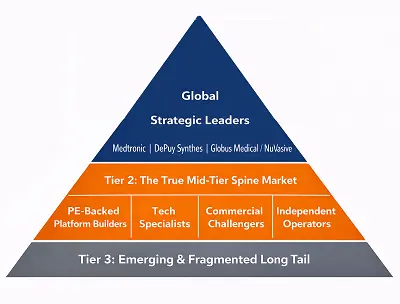
Tier 1: Global Strategic Leaders (“Big Spine”)
At the top sits a concentrated group of scaled strategics that effectively set the competitive ceiling for the entire sector.
Core Tier 1 players
- Medtronic
- DePuy Synthes (Johnson & Johnson)
- Globus Medical (including NuVasive)
What structurally defines Tier 1
- global direct sales infrastructure
- full procedural coverage
- deep biologics capabilities
- heavy enabling technology investment
- direct IDN and ASC contracting leverage
- ability to fund long clinical cycles
Strategic reality
Tier 1 players are no longer competing primarily on implant catalogs. They are building integrated procedural ecosystems and attempting to control surgeon workflow end to end.
Implication:
They continuously raise the cost of relevance for everyone else.
The real strategic complexity, however, sits below the global leaders.
Tier 2: The True Mid-Tier Spine Market
This is where the real competitive tension lives. However, the mid-tier is not homogeneous. It is better understood as four strategic archetypes, defined primarily by capital structure, commercial model and source of defensibility.
A) PE-Backed Platform Builders
Role: Internal consolidators
Key platforms
- Highridge Medical
- Zavation
- CoreLink
- ChoiceSpine
- VB Spine
- Companion Spine
What defines them?
- active buy-and-build strategies
- expanding procedural breadth
- focus on operating leverage
- improving manufacturing control
- clear medium-term exit logic
Outlook
These players currently have the strongest consolidation momentum inside the mid-tier. However, long-term success will depend on whether they can build true clinical and technological defensibility, not just scale.
B) Differentiated Technology Specialists
Role: Optionality through innovation
Core specialists
- SI-BONE
- 4WEB Medical
- Carlsmed
- Centinel Spine
- Spinal Simplicity
- Spineology
- GS Medical
- Providence Spine
What defines them?
- focused clinical narratives
- meaningful IP positions
- narrower portfolios
- variable commercial density
- high dependence on procedure adoption
Outlook
These companies can remain independent longer than most mid-tier players, provided their differentiation remains clinically relevant. If that edge erodes, they quickly become attractive tuck-in acquisitions.
C) Commercial Procedural Challengers
Role: Execution-driven growth
Primary names
- Alphatec (ATEC)
- Xtant Medical
- Astura Medical
- Amplify Surgical
- Curiteva
What defines them?
- strong field-facing commercial models
- procedural solution messaging
- evolving biologics positioning
- high execution dependency
Outlook
This model can generate impressive growth. But it is operationally unforgiving. Any sustained slowdown tends to expose structural limitations quickly.
D) Core Independent Mid-Tier Operators
Role: The broad middle under pressure
Established players
- Genesys Spine
- Life Spine
- Spinal Elements
- Aurora Spine
- Orthofix/SeaSpine
- CTL Medical
- Nexxt Spine
- Spine Wave
- Eminent Spine
What defines them?
- competent hardware portfolios
- loyal but often localized surgeon bases
- meaningful distributor reliance
- limited global density
- growing ASC exposure
- increasing biologics pressure
Outlook
This is the most structurally exposed segment of the mid-tier, including recently merged platforms still proving post-integration execution. Many are profitable and durable today, but competitive pressure is steadily increasing.
Tier 3: The Emerging and Fragmented Long Tail
Below the recognized mid-tier sits a highly fragmented layer that collectively fuels future consolidation.
Representative players
- Many emerging companies
- smaller regional manufacturers
- private-label/OEM suppliers
Structural reality
- subscale economics
- heavy distributor dependence
- limited clinical depth
- high price sensitivity
This layer remains the primary hunting ground for future tuck-in acquisitions.
Outlook
A handful will scale. Many will ultimately be absorbed into larger platforms.
Where Spine Consolidation Is Actually Heading?
The mid-tier spine market is now firmly in Phase Two of consolidation.
- Phase One was about assembling scale
- Phase Two is about proving durable differentiation
- Phase Three, later this decade, will reveal which platforms built truly defensible businesses
Across the mid-tier, five capabilities are increasingly emerging as the primary separation factors:
- commercial density in core markets
- enabling technology integration
- credible biologics or materials strategy
- strong ASC alignment
- economically viable distributor architecture
Many companies possess two or three.
Very few possess all five.
That is the quiet math reshaping the sector.
Bottom Line
The spine market is no longer a simple large-versus-small story.
- Tier 1 strategics continue to raise the competitive bar
- PE-backed platforms currently hold the strongest mid-tier momentum
- technology specialists retain meaningful strategic optionality
- commercial challengers must execute with precision
- and a broad independent mid-tier faces steadily increasing structural pressure
The mid-tier is not disappearing.
It is being selectively sorted.
And over the next three to five years, the winners will not be the companies with the longest catalog, but those that can repeatedly demonstrate clinical and economic relevance in a market that is becoming far less forgiving.
For many mid-tier companies, the next five years will determine whether they become consolidators… or inventory.