
We first published this article in 2025. We are now republishing it in updated form following the latest FDA approval in the single-use spine market, including Dual, one of the newest additions to this category.
Over the past two decades, spine surgery has evolved through advances in minimally invasive techniques, greater intraoperative precision, and a growing focus on efficiency inside the operating room. Within that broader transformation, single-use sterile instrumentation systems have moved from being a practical niche solution to becoming a serious topic of strategic debate.
Initially adopted as a way to address sterilization burdens in outpatient centers and resource-constrained hospitals, these systems are now gaining attention far beyond that setting. Even larger institutions operating under demanding frameworks such as the EU MDR and the FDA’s 510(k) process are increasingly evaluating their role. Companies such as Xenco Medical, WishBone Medical, Neo Medical, Trellis™, Safe Orthopaedics, Intelligent Implant Systems, and more recently Dual, illustrate the range of approaches now shaping the market, from fully disposable kits to hybrid and digitally integrated platforms.
So the question remains highly relevant in 2026: are single-use systems the future of spinal surgery, or are they still fundamentally a niche solution?
Before we dive into that, let’s take a closer look at some crucial factors influencing this shift:
Why are hospitals switching?
1. Breaking the chain of infection
Traditional reusable instruments require reprocessing, a cycle that inevitably carries contamination risks. Peer-reviewed studies show that 15-20% of postoperative infections can be traced back to failures in sterilization. Innovators such as Xenco Medical have shown that fully sealed, single-use kits nearly eliminate this risk—an important breakthrough, especially for patients who are most vulnerable.
2. The hidden economics of efficiency
Though the upfront cost of disposable systems can seem high, many forward-thinking hospitals are seeing significant savings. Studies report a 47% reduction in time between surgeries (Journal of Neurosurgery: Spine, 2022), elimination of hundreds of thousands of dollars in annual reprocessing expenses (Mayo Clinic pilot study), and a 92% drop in cases of missing or damaged instruments.
3. Regulatory winds of change
European regulations are spearheading this shift. For example, France’s 2023 medical device directive now demands dual sterilization processes for reusable implants, while Germany’s Robert Koch Institute requires disposable alternatives for high-risk surgeries. These tighter rules are pushing hospitals to reconsider their instrument choices.
What are the roadblocks to universal adoption?
1. Sustainability tradeoffs
The environmental impact of single-use systems is still a hotly debated issue. Although companies like Safe Orthopaedics offer biodegradable polymer kits with encouraging results, most disposable systems produce about 23% more medical waste per procedure compared to traditional instruments (WHO, 2023).
2. Cultural resistance
Surgeons often remain loyal to high-end reusable systems, such as Medtronic’s StealthStation, making change difficult. Adopting single-use instruments requires adjusting surgical workflows and techniques, and 68% of fellowship-trained spine surgeons report challenges due to ingrained “muscle memory” with reusable tools (Global Spine Journal). Prestigious centers like the Cleveland Clinic continue to maintain hybrid inventories to respect surgeon preferences.
Is the market for single-use spine systems growing?
Yes, the market is rapidly expanding, fueled by clinical needs, economic benefits, and evolving regulations. Forecasts estimate a compound annual growth rate (CAGR) of 12–15% through 2030, with the market size projected to reach between $2.8 and $3.5 billion, up from $1.2 billion in 2022. Adoption is especially strong in outpatient surgery centers, where 45% now use disposable systems for more than half of their cases. Hospitals show slower uptake—around 28% in the U.S.—but Europe is advancing more quickly, driven by tighter sterilization standards.
What are the leading systems on the market?
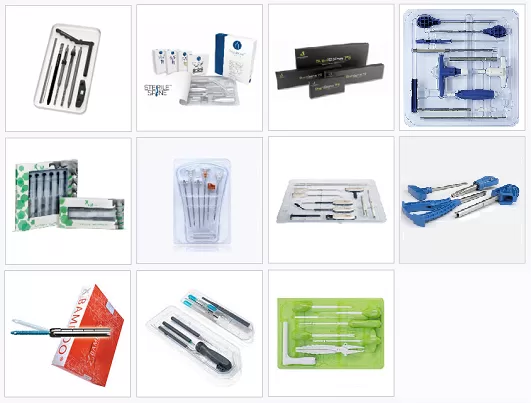
The market offers a variety of competitive systems, including:
- BoxSPINE:Duet System
- Trellis™Platform
- GetSet Surgical (Video Animation: GetSet Surgical: GoPLF Implant overview)
- WishBone Medical: STERILE SPINE™
- Xenco Medical (Video Animation: Xenco Medical: Single Use Spine Systems)
- Safe Orthopaedics (Video Animation)
- Providence Medical Technology: CORUS Spine System
- Neo Medical (Video Animation: Neo Medical ;Brochure: Neo-Pedicle-Screw-System-Neo.pdf)
- Intelligent Implant Systems (Video Animation)
- Evospine (Video Animation: Evospine: BAMBOO MIS)
- Vertiflex: Superion® with Single-Use Instruments (Video Animation)
- ECA Medical Instruments
- Innovative Surgical Designs
- The KG 2 Surge® Solution
Comparative analysis of the various systems:
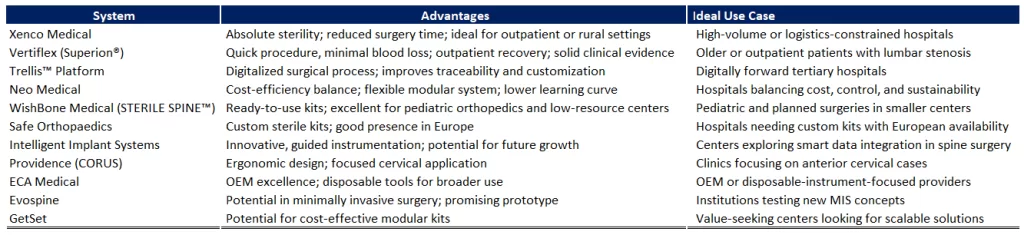
We’ve carefully reviewed the different systems based on several key criteria such as efficiency, usability, innovation, and clinical versatility:
What are the top 3 single-use spine systems?
After carefully evaluating all systems based on efficiency, usability, innovation, and clinical versatility, three stand out today as the most complete and well-rounded solutions. This does not mean the others are not valuable—quite the opposite. Many offer innovative, well-designed features and clearly contribute to the evolution of single-use spine instrumentation. However, for the purpose of a focused and practical assessment, we have highlighted those platforms that currently offer the most comprehensive combination of surgical efficiency, logistical simplicity, clinical relevance, and market readiness.
1. Xenco Medical
Xenco Medical earns a spot in the top three thanks to its fully disposable model, offering maximum sterility without the need for reprocessing. Its design simplifies hospital logistics and virtually eliminates the risk of cross-contamination. These features make it particularly suitable for high-volume centers, ambulatory surgery units, or hospitals operating under resource or time constraints. By significantly reducing surgical time and setup, Xenco provides a practical, efficiency-driven solution where speed and safety are critical.
2. Trellis™ Platform
The Trellis™ Platform stands out with its digitally integrated system that combines implants, data, and surgical workflow into one seamless solution. Its real-time traceability and workflow integration represent a forward-thinking approach to spinal surgery. This system allows for personalized treatment plans and supports complex multi-level procedures, while also enhancing postoperative tracking to improve patient outcomes. It’s particularly well suited for medium-to-large hospitals that are embracing digital technologies to advance their surgical capabilities.
3. Neo Medical
Neo Medical offers a hybrid model combining reusable and single-use components, featuring a modular design that optimizes cost-efficiency. This system strikes a balance between maintaining clinical control and promoting sustainability. With a shorter learning curve and flexible instrumentation, it adapts well to different hospital environments. Neo Medical is especially well suited for facilities aiming to improve efficiency without compromising surgical precision or control.
Honorable Mentions
- GetSet Surgical: While not as widely recognized as some major players, GetSet Surgical offers a solution focused on logistical efficiency and operational simplicity. Their system features sterile, single-use instruments, no-touch packaging, ergonomic sets with no assembly required—significantly reducing setup time and eliminating risks tied to reprocessing. While more functional than high-tech, their value proposition is especially appealing to hospitals looking to streamline OR efficiency without compromising safety. Their inclusion in this list is based on their ability to solve real-world operational challenges rather than on disruptive technology.Both Their products have been certified for use in Europe (CE Mark) and cleared for use by the US FDA 510(k).
- Safe Orthopaedics: Strong European player; sterile kits with proprietary implants, but less globally deployed.
- Vertiflex (Superion®): Excellent for outpatient lumbar stenosis cases, but limited to mild/moderate indications.
- WishBone Medical (STERILE SPINE™): Great for pediatric orthopedics and resource-limited environments; less focus on MIS.
- ECA Medical: It’s importance is undeniable, but its role is more that of a critical enabler behind leading solutions than a front-facing market competitor with a branded, ready-to-use spinal surgery system.
Are They the Future? Will disposable systems reshape the standard of care, or remain niche solutions for select scenarios?
Yes—but not for everyone.
Single-use spinal surgery systems are indeed growing in adoption, but they are not a one-size-fits-all solution. For high-volume hospitals, centers with limited logistics or sterilization capacity, these systems offer unmatched convenience, reliability, and efficiency. Their use is particularly well-suited for ambulatory and minimally invasive surgeries where sterility and speed are paramount.
However, for more complex cases — such as deformities, multi-level fusions, or revision surgeries — challenges persist. Concerns about mechanical strength, flexibility of instrumentation, and surgeon feedback remain significant barriers.
Sustainability is emerging as a critical factor. Environmentally conscious regions will increasingly demand reduced medical waste, recyclable materials, or hybrid systems. Companies like Neo Medical, with their balanced reusable and disposable models, are well-positioned to meet these demands.
Spinal surgery is clearly entering a new era where single-use and hybrid systems will play an essential role. They will not entirely replace traditional reusable systems but will smartly complement them, becoming indispensable for a growing share of procedures.
As with any technological shift, the key is not to replace what works, but to smartly complement it with what can work better.
###
Legal Disclaimer:
Content published on SPINEMarketGroup (thespinemarketgroup.com) is provided for informational purposes only and on an “as is” basis, without warranties of any kind. We do not guarantee the accuracy, completeness, legality, or reliability of any information, images, videos, links, or third-party materials featured on the site. Any views or claims expressed in contributed content or press releases belong to their respective authors or sources. For copyright concerns, factual corrections, or content-related complaints, please contact us directly for review: spinemarketgroup@gmail.com