
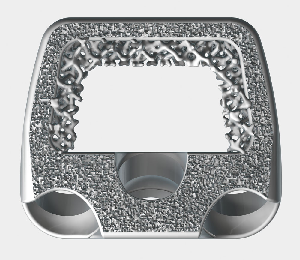
STALIF C FLX is a 3D-printed porous titanium cervical interbody with 2-level clearance! STALIF C FLX is built upon the simple, elegant design and proven success of the STALIF foundation with the Unique 3D-Printed Porous Titanium FLX Solution that offers the following advantages:
Flexible
FLX implants include a solid exoskeleton for added strength, along with a proprietary lattice scaffold designed to have a stiffness similar to bone. Reduced device stiffness is known to minimize stress-shielding and enhance the fusion process.
Lucent
FLX implants include porous radiolucent sections with optimized density to reduce imaging artifacts—enhancing intra-operative visualization & post-operative fusion assessment compared to solid titanium implants.
MatriX
FLX implants include a FUSE-THRU™ osteoconductive trabecular scaffold, bioengineered to allow the potential for bony on-growth and in-growth throughout the implant. This unique porous structure contains micro, macro, and nano structural characteristics designed to promote the fusion healing process by influencing cellular events related to the production of new bone.
- STALIF C VIDEO ANIMATION (Centinel Spine Old version)
- STALIF C-SGT VIDEO ANIMATION (Centinel Spine Old version)
Which are the Main STALIF C FLX Advantages?
- No Profile®; No Supplemental Fixation
- The integrated cage and screw system of STALIF C FLX is cleared for use without supplemental fixation, while the “No Profile” design allows it to nest fully within the confines of the vertebral body—leaving the anatomy unchanged external to the interbody.
- The Lag Effect
- Compressive lag fixation ensures biomechanical stability and provides secure graft-endplate contact. Lag screws reduce the vertebral bodies onto the cage creating graft / endplate surface compression to provide the best opportunity for fusion.
- Biomechanical Equivalence
- The STALIF C FLX device is engineered to achieve equivalent biomechanical performance to anterior plate & cage technologies.1 Stein MI, Nayak AN, Gaskins RB, Cabezas AF, Santoni BG, Castellvi AE; Biomechanics of an Integrated Interbody device versus ACDF anterior locking plate in a single-level cervical spine fusion construct. Spine J., January 2014; 14(1):128-136.
Which are the Main STALIF C FLX Features?
- Anti Back-Out® Screws
- STALIF C FLX screws provide an added layer of security with an Anti Back-Out® (ABO®) titanium split-ring which first compresses and then deploys during insertion.
- Large Graft Area
- The implant is designed with a large, open, concave graft containment cavity to maximize the volume of bone graft (allograft and/or autograft) material to better promote fusion.
- Multiple Heights & Footprints
- The STALIF C FLX Interbody system consists of varying heights and footprint options to accommodate individual pathology and anatomical conditions.
About Silony Spine
Silony Spine is disrupting the spinal surgery marketplace with compatible options for enabling technology systems. Check out our portfolio of precision tools and hardware that add significant value and freedom of choice.Website: https://www.silonyspine.com/