• Skip to main content
  • Skip to secondary menu
  • Skip to primary sidebar
  • Skip to footer
  • MANUFACTURERS
  • HEADHUNTERS
  • COMPANIES

SPINEMarketGroup

Spine Industry News

  • HOME
  • 2026
  • 2025
  • 2024
  • BROCHURES
  • ARTICLES
  • PRODUCT LIBRARY

Spinal Resources Inc. Announces Publication in Spine Deformity of Impact of a Novel Patient-Specific, Patient-Matched Bezier Parametric Curve Rod Platform on Proximal Junction Biomechanics in an in Silico Thoracolumbar Fusion Model

August 1, 2025 By SPINEMarketGroup

FORT LAUDERDALE, Fla., July 31, 2025 /PRNewswire/ — Proximal junctional kyphosis (PJK) and failure (PJF) remain the bane of spinal deformity surgeons’ existence.  While many methods (i.e. tether, cement augmentation, “ideal” alignment) have been proposed to decrease rates of PJK/PJF, they have not significantly moved the needle in this regard. Among the risk factors for PJK/PJF, the stiffness of the construct, influenced by choice of rods, is one that surgeons can control.  One major limitation of rods for spinal deformity corrections is that single diameter rods (i.e. 5.5mm, 6.0mm, 6.35mm) cannot provide the needed strength to correct deformities while also providing a biomechanically friendly transition at the junction of constructs. 
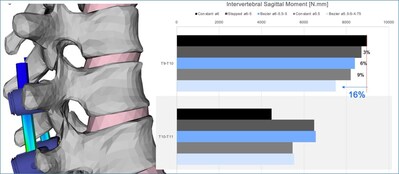
Figure 1. Intervertebral sagittal moment sustained by the upper instrumented segment and the one adjacent to the instrumentation under flexion for the 5 instrumentation scenarios.
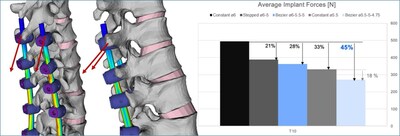
Figure 2: Average force magnitude sustained by the two proximal pedicle screws under flexion for the 5 instrumentation scenarios.

According to Dr. Alekos Theologis, Associate Professor, UCSF Orthopaedic Surgery, “Most recently, Spinal Resources Inc. (SRI) has developed unique rods, termed “Bezier surface-smoothed transition rods”, that vary in stiffness based on local rod section diameter.  Bezier rods are patient-specific and can be designed with greater stiffness where additional stiffness is needed (i.e. across 3-column osteotomies, multilevel posterior column osteotomies, lumbosacral junction) while maintaining flexibility near the junctional vertebrae so as to promote a biomechanical “soft landing” at the junction between the instrumented spine and native/non-instrumented spine.”  The biomechanical benefits of this rod have now been published in the Spine Deformity Journal in July 2025.

Dr. Theologis continues, “Specifically, in this finite element analysis, it was found that Bezier rods provided smoother load transitions and better offloading of proximal segments compared to constant diameter rods. The highest moment sustained by the segment adjacent to the instrumentation was observed with the constant 6mm rods, while the Bezier 5.5-5-4.75mm rod showed the lowest moment, indicating reduced stress of 16% on the upper adjacent vertebrae (Figure 1). Similarly, the Bezier rods were more effective in offloading pedicle screws up to 45% with respect to the stiffer rod construct. (Figure 2).”

Dr. Saeed S. Sadrameli, M.D., Board Certified in Neurosurgery, specializing in endoscopic and patient-specific minimally invasive/robotic spine surgery, Advent Health points out, “The underlying design principle applies equally to long, complex deformity constructs and shorter segmental fusions, where junctional stress and implant fatigue remain a concern. The Bezier technology marks a shift toward biomechanically optimized and personalized instrumentation, delivering stiffness and compliance precisely tailored to each region of the spine.”

Dr. Sadrameli continues, “Tailored to each patient’s anatomy and surgical plan, the Bezier rod shows strong potential to mitigate common mechanical complications in spinal fusion, such as Proximal Junctional Kyphosis (PJK), by optimizing load-sharing between the rod and the spine at critical spinal regions.”

According to Bernie Bedor, SRI President and CEO, “These are extremely promising and exciting findings that lend strong support for and validate SRI’s Bezier Parametric Curve Transition Rods’ potential in reducing the risk of PJK/PJF following adult and pediatric spinal deformity operations.”

About Spinal Resources Inc.

Spinal Resources Inc.® is a Ft. Lauderdale, Florida based spinal medical device company that supports cost-effective patient care with innovative mechanical and bio-mechanical products to alleviate pain, shorten recovery time, restore health, and extend quality of life.

SOURCE Spinal Resources Inc.

Related Posts:

  • Proximal Junctional Kyphosis (PJK): A Common Issue…
  • Patent Issued for Variable-Dimension Fixation Rod…
  • First-of-its-kind Universal Clearance Establishes…

Filed Under: NEWS Tagged With: 2025

Primary Sidebar

PLATINUM SPONSORS

EXALTA 2LOGO-min
GLOBAL biomedica
NORMED newLOGO-min
GENESYS SPINE
SPINEGUARD2025
Dymicron 2
GSMEDICAL2025
spinewaygroup
RUTHLESS SPINE
RUDISHAUER
NGMEDICAL
LfC
ispine
CENTINEL SPINE
TSUNAMI MEDICAL
syntropiq logo
A-SPINE
L&Kmodelo log

POPULAR POST LAST 90 DAYS

  • Is DePuy Back in the Spine Fight? Why DePuy Really…
  • BROCHURES
  • What Globus Medical Really Bought With Higgs Boson Health
  • Globus Medical Announces Acquisition of Higgs Boson…
  • Highridge Medical CEO Departure: Spine’s…
  • DePuy Synthes for Sale: Who Could Actually Buy the…
  • Thinking About a Spine Robot? Your 2026 Guide to the…
  • Are Pedicle Screw Lawsuits Becoming a…
  • (UPDATED 2025): 6 Artificial Cervical Discs You’ll…
  • Strong Surgery, Soft Quarter: ATEC and the Cost of…
  • COMPANIES
  • The Giant Next Door: Is Mindray Spine’s Next…
  • DePuy Synthes Acquires Expanding Innovations™
  • Globus Medical Reports Second Quarter 2026 Results
  • Forty Cervical Discs, One 3% Market: The Fight to…
  • (2025 Update): Market, Leading FDA-Approved Devices,…
  • (UPDATED 2026) More Than 100 Options, No Single…
  • CD HORIZON® SOLERA™ System
  • Who Is PAULA, and Why Should Every Deformity Surgeon…
  • Johnson & Johnson Explores Potential $20B Sale…
  • Orthopedics Is Moving Into Pain. Zimmer and Globus…
  • Percutaneous MIS Spine Systems: Why Adoption Still…
  • ProFlex Spine: Can a Nitinol Implant Crack…
  • Globus Medical: Stronger in Spine, but Could DePuy…
  • L&K Spine Performs First U.S. Deformity Case…
  • Top Expandable Cages of 2025: Which Lumbar Implants…
  • CarboFix Spine Launches CarboClear® Hybrid MIS…
  • Orthofix Discontinues M6-C™ and M6-L™ Artificial…
  • Managing Early-Onset Scoliosis: Which…
  • Xenix Medical Announces FDA Clearance and Full…
  • LAST 5 VIDEOS PUBLISHED

    1. Xenix Medical: Riva Modular Fixation System
    2. Spinal Elements: Overwatch® PCF
    3. Mighty Oak: Acorn 3D™
    4. Syntropiq: Lyra
    5. ATEC Spine: SafeOp®

    Footer

    Contact us:

    spinemarketgroup@gmail.com info@thespinemarketgroup.com

    • LinkedIn
    • Twitter
    • YouTube

    PRIVACY POLICY

    • Legal
    • PRODUCT LIBRARY

    Copyright © 2026 · SPINEMarketGroup