
How HAPPE Spine is reshaping the future of spinal fusion with a bioactive, porous technology born in a university lab
In July 2023, a surgery took place in Indiana that may have quietly opened the door to a new chapter in spine care. Dr. Stephen Smith, a neurosurgeon at Beacon Health System, performed the first implantation of a cervical interbody device unlike anything seen before—an implant that doesn’t just support fusion, but actively participates in it.
The implant was developed by HAPPE Spine, a company founded by biomedical engineer Dr. Ryan Roeder and Dr. Smith himself, after years of collaboration that began at the University of Notre Dame. The technology is the result of nearly two decades of research into how biomaterials can better interact with the human body, and it addresses a longstanding challenge in spinal fusion: getting bone to grow through an implant, not just around it.
Traditional interbody cages—often made of PEEK (polyetheretherketone)—are biocompatible and mechanically suitable, but they’re biologically inert. They don’t bond with bone, and in some cases, they can even interfere with healing. Titanium cages, meanwhile, offer better biological performance but come with imaging artifacts and stiffness mismatch issues.
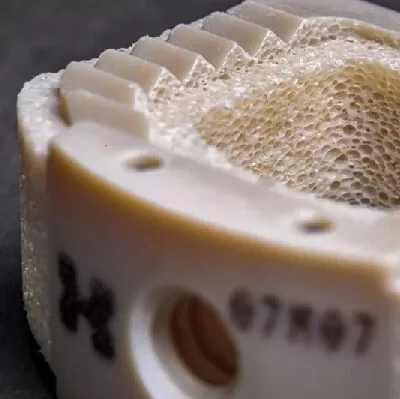
The new implant developed by HAPPE Spine takes a radically different approach by combining:
- A fully interconnected 3D porous architecture, mimicking the structure of trabecular bone, allowing for vascularization and osteoblast infiltration.
- Bioactive surfaces, created by infusing hydroxyapatite—a natural component of human bone—into the PEEK matrix, turning the implant into a biologically active scaffold.
This design allows bone to grow not only along the outer surface, but directly into the structure of the implant itself. In essence, the implant becomes part of the fusion—not a bystander.
Dr. Smith describes the difference this makes in real-world outcomes:
At six weeks, we’re already seeing bone penetrating the device. At six months, we’re seeing solid fusion. That’s something we just don’t see with traditional cages. Early healing changes everything—because if you miss the early window, your odds of revision surgery go up, and your chances of success go down.”
The implications are major. Revision surgeries are complex, costly, and carry increased risks for patients. A device that accelerates and strengthens natural fusion could mean faster recoveries, fewer complications, and better long-term outcomes.
But getting to this point wasn’t simple.
Despite promising early results in the lab, the technology sat idle for years—unable to attract the funding needed to navigate regulatory and commercial hurdles. Roeder and Smith encountered what many researchers know too well: the so-called “valley of death” between academic innovation and real-world application.
With no investors willing to take the early risk, they took it themselves. They co-founded HAPPE Spine, built a team, and brought the device through development and regulatory clearance.
Now, the first surgeries have been performed. The early data is compelling. And the implant is no longer just a prototype—it’s on the market, and it’s helping real patients heal.
What makes HAPPE’s material so unique is the integration of hydroxyapatite into the PEEK matrix, enabling both strength and biological activity in a single component. This allows surgeons to maintain the mechanical advantages of PEEK—like radiolucency and an elastic modulus similar to bone—while achieving bone integration typically only seen with metals or grafts.
In a field where innovation often means small, incremental changes, HAPPE’s device is something different: a platform with the potential to redefine how spinal fusion is approached.
It’s not just a better cage—it’s a biologically inspired, regenerative implant that transforms the fusion process.
In the words of Dr. Roeder:
“We didn’t want to just improve the implant. We wanted to change what it means for a spinal implant to work. That meant designing for biology, not just mechanics.”
With its first successful cases and a growing body of clinical evidence, HAPPE Spine is showing that when science and surgery come together, real innovation is possible.
And perhaps, this is just the beginning.
SOURCE: https://www.nd.edu/stories/finding-fusion/
About HAPPE Spine
HAPPE is an emerging leader of next generation orthopaedic and spinal implants enabled by the HAPPE™ (HydroxyApatite Porous PolyEtheretherketone) platform. The HAPPE material platform offers interconnected, cancellous porosity with exposed hydroxyapatite on pore surfaces to enable robust bone in-growth and on-growth confirmed in preclinical testing.Website: https://happeortho.com