
Anterior cervical discectomy and fusion (ACDF) is one of the most standardized procedures in spine surgery. The workflow is familiar: decompression, controlled distraction, sizing, and insertion of a static interbody cage. For decades, this has worked reliably and predictably.
So when expandable cages appeared in the cervical spine, the reaction was immediate and reasonable:
What problem are we actually solving?
Unlike lumbar surgery, where expandable cages transformed surgical strategy, the cervical spine presents a very different biomechanical environment. Disc spaces are small, neural structures are close, and sagittal alignment depends more on global balance than on a single intervertebral level. In most cases, Caspar distraction already provides precise height restoration before the implant is even inserted.
Which is why expandable cervical cages have never become a mainstream category.
A Very Small Club
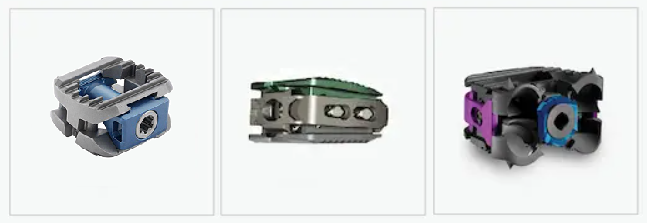
If we limit the discussion to true in-situ expanding ACDF cages — meaning implants that increase height after insertion inside the disc space — the list is remarkably short:
- L&K SPINE BluEX-C-Expandable
- Atlas Spine — HiJak ACDF Expandable
- Globus Medical — REVEL-C Expandable
And that is essentially the entire category in real clinical practice.
Many devices marketed as “expandable” are actually:
- modular heights
- wedge options
- distraction-assisted placement
- or expansion occurring before insertion
Those are useful designs, but biomechanically they are not the same concept.
Why Cervical Expansion Is Different From Lumbar
In lumbar fusion, expansion can restore alignment and foraminal height in a meaningful structural way.
In cervical fusion, the goals are subtler.
The cervical disc typically measures only a few millimeters in height. A small change can significantly alter foraminal dimensions, but excessive distraction may create symptoms rather than solve them. As a result, surgeons already rely on controlled external distraction rather than implant-driven correction.
In other words:
Lumbar expandable cages create alignment.
Cervical expandable cages fine-tune tension.
That difference alone explains why adoption has been limited.
A Different Direction: Controlling Load Instead of Expanding
Not all companies have approached the cervical biomechanical problem through expansion or fusion. Some have explored whether preserving controlled motion could address similar concerns from the opposite direction.
An example is the DCI from Paradigm Spine.
Rather than distracting the disc space or promoting fusion, this dynamic intersomatic implant is designed to share load while allowing controlled motion. Its philosophy illustrates a recurring theme in cervical biomechanics: sometimes the goal is not to increase structural correction, but to manage how forces are transmitted across the segment.
The existence of such devices helps explain why expandable ACDF cages remain a niche — the cervical spine often rewards load modulation more than structural expansion.
Where Expandable Cages Actually Help
Expandable cervical cages are not designed to replace standard ACDF implants.
They exist for situations where impact insertion is not ideal.
Typical scenarios include:
- severely collapsed foramina
- revision surgery with compromised endplates
- osteopenic bone
- desire to minimize impaction forces
- millimetric adjustment of ligament tension
In these cases, gradual expansion inside the disc space may distribute load more gently than forcing a final-height cage into position.
For the majority of routine ACDF procedures, however, traditional cages remain entirely sufficient.
Then Why Do Companies Build Them?
The answer is not that ACDF is broken.
It is that spine surgery values control.
Even if only a small percentage of procedures benefit from adjustable expansion, surgeons remember the device that solved the difficult case. From an industry perspective, niche tools can matter as much as high-volume implants.
There are also broader reasons:
- differentiation in a saturated cervical market
- transfer of concepts developed in lumbar surgery
- incremental engineering development
- surgeon preference in complex cases
Not every implant is meant to dominate a category. Some exist to extend its boundaries.
The Reality
Expandable cervical cages are unlikely to replace traditional ACDF implants. The biomechanical demands of the cervical spine simply do not reward large in-situ expansion the way the lumbar spine does.
Instead, they occupy a narrow but legitimate role:
a precision instrument rather than a universal solution.
For most ACDF procedures, the standard cage remains predictable and efficient.
For select cases, controlled expansion offers a different kind of advantage — not more correction, but more control.
And in spine surgery, control often matters more than force.
###
Legal Disclaimer
The information presented in this article is intended solely for educational and informational purposes related to medical technology and industry discussion. It does not constitute medical advice, surgical guidance, or clinical recommendation. Clinical decisions must always be based on the independent judgment of qualified healthcare professionals, considering individual patient conditions and applicable regulatory approvals in each jurisdiction.
Product names, trademarks, and technologies mentioned belong to their respective owners. Any reference to specific devices is descriptive in nature and does not imply endorsement, comparative performance claims, or commercial preference.