
Proximal Junctional Kyphosis (PJK) is a postoperative spinal deformity defined by an abnormal increase in kyphosis at the upper end of a spinal fusion construct. In simple terms, it occurs at the transition between a rigid, instrumented segment of the spine and the adjacent, non-instrumented vertebrae above.
This junction is biomechanically vulnerable. When a long and rigid spinal construct abruptly meets a more flexible spinal segment, high mechanical stresses can develop at this interface. Over time, these stresses may lead to progressive deformity, pain, and in severe cases, Proximal Junctional Failure (PJF), often requiring revision surgery.
Why PJK matters in deformity surgery?
Although sometimes considered a secondary complication, PJK can significantly affect long-term outcomes after spinal deformity correction. It is associated with increased postoperative pain, loss of sagittal alignment, higher revision rates, and reduced patient satisfaction.
For this reason, modern deformity surgery focuses not only on achieving correction, but also on how mechanical forces are transferred along the spinal construct.
The stiffness transition problem
One of the main contributors to PJK is the abrupt change in stiffness between a rigid fusion construct and the mobile spine above it. Traditional rigid rods provide strong fixation but can unintentionally concentrate stress at the proximal junction.
Historically, PJK prevention has relied on surgical techniques such as careful selection of the upper instrumented vertebra, the use of hooks or sublaminar bands, ligament reinforcement, and sagittal alignment optimization. However, these strategies do not directly address the biomechanical issue of stiffness transition.
A biomechanical transition-focused approach
Hybrid or transition rod concepts were developed to directly address this problem. These rods aim to create a gradual transition from rigid fixation to more flexible motion, reducing stress concentration at the proximal junction and allowing a more physiological load distribution.
Solutions to prevent Proximal Junctional Kyphosis (PJK)
There is no single solution that completely prevents Proximal Junctional Kyphosis (PJK). In clinical practice, prevention is multifactorial and usually involves a combination of surgical planning, adjunct techniques, and biomechanical strategies.
1) Proper selection of the proximal fusion level (UIV)
Choosing the correct Upper Instrumented Vertebra (UIV) is critical.
- Avoid stopping the construct in highly mobile transition zones
- Take global sagittal alignment into account
- Adapt the strategy to patient factors such as age and bone quality
This step is essential, but by itself it does not eliminate PJK risk.
2) Optimization of sagittal alignment
Overcorrection is a well-known risk factor for PJK.
- Respect age-adjusted alignment targets
- Avoid aggressive correction, especially in fragile patients
- Focus on balance rather than “perfect” alignment
Many PJK cases result from corrections that are technically successful but biomechanically excessive.
3) “Soft-landing” techniques at the proximal end
These techniques aim to soften the transition between the rigid construct and the mobile spine.
Common approaches include:
- Using hooks instead of pedicle screws at the proximal level
- Sublaminar bands
- Preserving posterior ligaments and musculature
These methods can help, but their effectiveness is highly technique-dependent.
4) Proximal ligament augmentation (tethering)
Ligament augmentation uses bands or sutures to reinforce the proximal junction.
- Reduces stress on the upper junction
- May slow PJK progression
- Evidence is growing, but results are variable
This approach works as a complement, not a standalone solution.
5) Prophylactic vertebral augmentation (selected cases)
Mainly used in patients with poor bone quality.
- Vertebroplasty or kyphoplasty at UIV or UIV+1
- Reduces fracture risk at the proximal junction
- Does not address the underlying stiffness mismatch
Useful in specific patients, but not broadly applicable.
6) Managing construct stiffness (the key biomechanical issue)
At its core, PJK is largely caused by a sudden stiffness change between:
- a long, rigid spinal construct
- and the adjacent, non-instrumented mobile spine
Most traditional prevention strategies do not directly address this mechanical transition.
7) Hybrid rods and stiffness-transition solutions
At present, and based on current knowledge, the only product specifically designed to directly manage stiffness transition with the goal of reducing PJK risk is the recently launched hybrid rod from Tria Spine, integrated within the Tria Spine Hybrid Rod System.
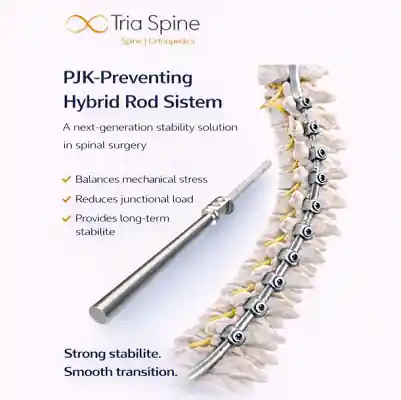
This hybrid rod is designed to address the key biomechanical mechanism behind PJK: the sudden stiffness change between a long rigid construct and the adjacent mobile spine. Its design allows a gradual stiffness transition, helping to avoid stress peaks at the proximal end of the construct.
Key advantages include:
- more physiological load distribution
- reduced stress concentration at the proximal junction
- mechanical behavior closer to natural spinal motion at the transition zone.
The hybrid rod acts as a shock-absorbing element that helps reduce the risk of both PJK and PJF without compromising overall construct stability or correction goals.
Conclusion
PJK is not just a technical complication. It is a biomechanical consequence of how stiffness is managed along the instrumented spine. Controlling the transition between rigid fixation and natural spinal motion is essential to improve construct durability and long-term outcomes.
In this context, solutions specifically designed to address this biomechanical challenge, such as the Tria Spine hybrid rod, represent an important step forward in PJK prevention.
###